
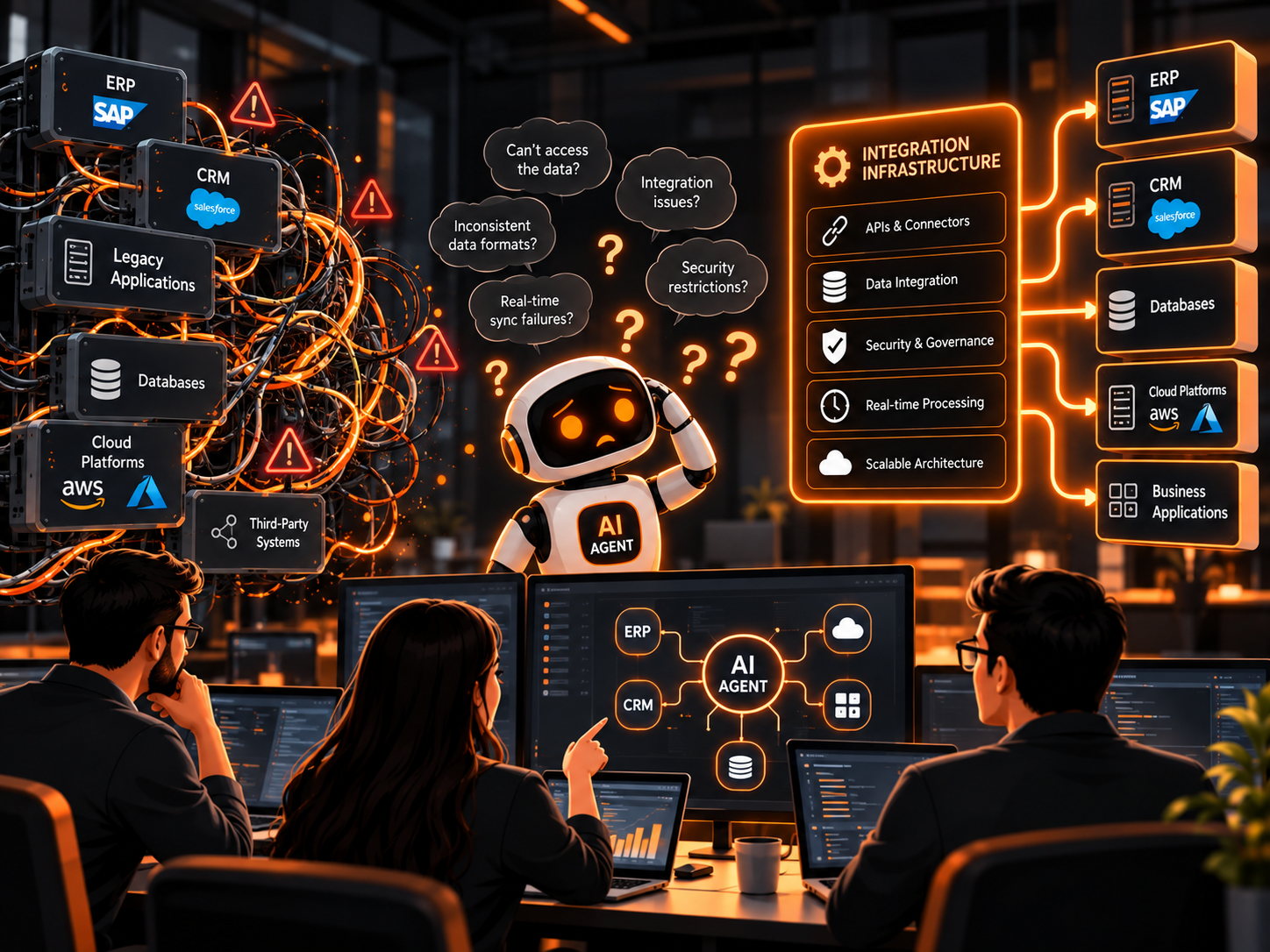
You greenlit the AI initiative. You hired the right people. You picked a reputable model. You ran the pilot.
And then — nothing worked the way it was supposed to.
If this sounds familiar, you’re not alone — and you’re not the problem.
In over two decades of enterprise technology delivery, across logistics, financial services, aerospace, life sciences, and manufacturing, we’ve seen the same pattern repeat itself with striking consistency: the AI initiative stalls, the team gets blamed, and the real culprit walks free.
The real culprit is never the model. It’s rarely the team. The public narrative blames model quality, the talent gap, or change management. Those are real issues. But they’re not the primary reason most Enterprise AI Solutions and agents collapse.
The real reason is quieter, less visible, and far more costly to ignore: your integration infrastructure is broken, and your AI agent is sitting on top of it.
This article is for CTOs and enterprise technology leaders who are tired of being sold on AI capability and want an honest answer to why it keeps failing in practice.
The “Brain vs. Spine” Problem in Enterprise AI
There’s a useful way to think about enterprise AI systems. The AI model — your LLM, your agent, your automation layer — is the brain. It reasons, responds, and acts.
But your integration infrastructure is the spine. It connects the brain to the body: to your ERP, your CRM, your mainframe, your supply chain systems, your customer data, your operational logic.
Here’s what no one in the AI vendor space wants you to hear: a brilliant brain connected to a broken spine cannot function.
Enterprise organizations have spent decades building application ecosystems that were never designed to work together. According to the MuleSoft Connectivity Benchmark Report, the average enterprise now connects 900+ cloud-based applications. Many of these communicate in different protocols, different data formats, and through one-off point-to-point integrations that were built under deadline pressure and never revisited.
When you drop an AI agent into this environment and ask it to take meaningful action — book a shipment, update a customer record, trigger a procurement workflow — it immediately hits a wall. Not because the AI is wrong. Because the data it needs is fragmented, stale, locked behind incompatible APIs, or simply unavailable in real time.
The brain is fine. The spine is broken.
What “Fragmented Data” Actually Looks Like in Practice
The phrase “fragmented data” gets thrown around a lot in technology strategy conversations. Let’s make it concrete.
Imagine you’re running a logistics operation and you want to deploy an AI agent that can proactively alert brokers when a shipment is at risk of delay. Straightforward use case. Real business value.
Here’s what the agent needs to do this:
- Real-time carrier location data
- Live traffic and weather feeds
- Current customer SLA thresholds from the CRM
- Active shipment status from the TMS
- Driver hours-of-service data from a compliance system
- Historical delay patterns from a data warehouse
In a well-integrated enterprise, this data flows freely. An agent can query it, synthesise it, and surface an alert in seconds.
In a typical enterprise, this data lives in six different systems, three of which don’t have modern APIs, two of which require batch processing that runs overnight, and one of which sits on a mainframe that communicates via a protocol your developers haven’t touched in a decade.
The AI agent doesn’t fail because the model can’t reason. It fails because the integration layer isn’t there to support it.
Three Symptoms That Tell You Integration Is Your Real Problem
Before you spend another dollar on AI tooling, ask yourself whether any of these scenarios are true for your organisation.
1. Your data pipelines still run on batch cycles
If your business intelligence refreshes every 24 hours, your AI agent is reasoning on yesterday’s data. For an investment firm, that’s a fiduciary risk. For a logistics operation, it’s a service failure waiting to happen. Real-time AI requires real-time data, and real-time data requires event-driven integration — not scheduled batch jobs.
2. Your IT team spends more time on integration maintenance than on new capabilities
This is the most telling sign. When integration is brittle — when every point-to-point connection requires manual maintenance, when a system update downstream breaks three things upstream — your engineering capacity is consumed entirely by keeping the lights on. There is no bandwidth to build the integration scaffolding that AI agents need to be effective. This is the “60% of IT time firefighting” problem, and it’s more common than most CTO will publicly admit.
3. You can’t answer the question “what is the single source of truth for X?”
Pick any critical data entity — a customer, a shipment, an asset, a financial record — and ask where the authoritative version lives. If the answer is “well, it depends” or “we have multiple systems that should be in sync,” you have a data integrity problem that no AI agent can overcome. The agent will make decisions based on whichever version of the truth it can access, which may be wrong.
What Integration Maturity Actually Looks Like
Here’s the distinction that separates enterprises where AI succeeds from those where it doesn’t: integration maturity.
Mature execution in Automation & Integration Services is not about having a lot of integrations. It’s about having the right architecture — one designed around a central communication hub rather than a web of point-to-point connections.
At Shvintech, we call this the Enterprise Message Bus (EMB) model. The principles are straightforward, though the execution requires real expertise:
Standardised data transformation. Every system in your ecosystem should communicate through normalised data formats — JSON, XML, EDI, or proprietary schemas all translated into a common language so that any system can speak to any other system without custom adapters.
Protocol-agnostic transport. REST, SOAP, MQ, JMS, proprietary protocols — a mature integration layer bridges all of them. Your AI agent shouldn’t need to know or care what protocol the downstream system uses.
Event-driven architecture. Data changes propagate in real time. When a carrier updates a shipment status, that update flows immediately to every system that needs it — including your AI agent’s context window.
Centralised error visibility. When something breaks, you know about it immediately and you can resolve it without manual data reconstruction. No data loss. No blind spots.
Single pane of glass. Every integration, every data flow, every error is visible from one monitoring layer. Your AI agent — and your human teams — always know what’s happening.
A Real Case: What Happens When You Fix the Spine First
One of Shvintech’s transportation and logistics clients came to us with a familiar set of symptoms. Their CRM didn’t connect to their ERP. Their mainframe communicated in one protocol while their microservices expected another. Every integration had been built as a one-off, and the team was spending over 60% of their time firefighting integration failures rather than building new capability.
They weren’t initially talking to us about AI. They were talking about survival.
As detailed in our Enterprise Message Bus (EMB) Case Study, we built an Enterprise Message Bus — deployed as a SaaS model to reduce infrastructure overhead — that created a centralized real-time communication hub across their entire application landscape. The architecture handled data transformation, protocol negotiation, backward compatibility with legacy systems, and non-functional standards like security and high availability.
The immediate outcome: a unified integration layer with zero single points of failure in production, real-time data exchange across all systems, and a dramatic reduction in integration firefighting.
The downstream outcome — and this is the part worth noting — is that this client now has the infrastructure to actually deploy AI agents that work. Because the data is clean, available, and flowing in real time. Because a broken integration doesn’t cascade into a broken AI decision. Because there is a single source of truth.
They didn’t start by asking “how do we do AI?” They started by asking “how do we make our systems actually work together?” The answer to the second question is what makes the first question answerable.
Why This Problem Persists (And Why It’s Getting Worse)
You might reasonably ask: if integration is the foundational problem, why hasn’t it been solved?
The short answer is that most organisations have taken a tactical approach to integration for twenty years. Build the integration you need right now, with the tools you have, to solve the immediate problem. Ship it. Move on.
The compounding effect of this approach is what we call integration debt — and it behaves like financial debt. It’s manageable when small, uncomfortable when medium, and genuinely dangerous when large. Most enterprises with 20+ years of technology history have significant integration debt, and every new AI initiative sits on top of it.
The longer answer is incentive structures. Integration infrastructure is invisible when it works and catastrophic when it fails. It rarely gets the investment priority of a new customer-facing product or a flashy AI pilot. And so it accumulates.
Reflecting a core takeaway from Gartner AI Strategy Insights, the irony of the current AI moment is that it’s forcing integration into the spotlight. Not because AI has changed what integration needs to do, but because AI makes the consequences of broken integration impossible to hide. When a human analyst makes a decision on stale data, the error is localised. When an AI agent makes ten thousand decisions a day on stale data, the error is systemic.
What CTOs Should Be Asking Their Teams Right Now
If you’re preparing to scale AI capability in your organisation, here are the questions that matter — before you ask anything about model selection or agent design:
- What percentage of our data is available in real time vs. batch? If the answer is less than 50% real-time, you have an integration problem that will constrain every AI initiative you launch.
- How many point-to-point integrations are we maintaining? If the number is high and growing, you’re accumulating debt, not building capability.
- What is our mean time to detect and resolve an integration failure? If the answer is measured in hours or days, your AI agents will be reasoning in the dark regularly.
- Do we have a centralised visibility layer across our integration landscape? If not, you lack the observability needed to trust what your AI agent is doing.
- What would it cost us to onboard a new system to our integration layer? If the answer is “months of custom development,” your integration architecture is a bottleneck, not an enabler.
These questions are uncomfortable. They’re also essential. The gap between a pilot that impresses and a production system that delivers comes down, almost every time, to the answers.
The Path Forward: Infrastructure First, Intelligence Second
The organisations that will win the AI era are not the ones that moved fastest to deploy agents. They’re the ones that built the infrastructure that makes agents reliable, observable, and genuinely useful.
That means investing in integration architecture before AI tooling. It means treating data availability and data quality as first-class engineering concerns. It means building the spine before you upgrade the brain.
The good news: this is solvable. The integration infrastructure problem is hard, but it is not novel. Shvintech has been building enterprise integration architecture for over 20 years — across transportation, logistics, financial services, life sciences, aerospace, and manufacturing. The patterns are well understood. The platforms exist. The expertise is available.
What’s required is the willingness to diagnose the actual problem rather than reach for the most visible solution.
What Shvintech Does Differently
We don’t arrive with an AI product and a pitch deck. We arrive with a diagnostic — a rigorous assessment of your integration landscape, your data architecture, and the gap between where you are and where you need to be to make AI actually work.
From there, we build. Our Enterprise Message Bus architecture, our event-driven integration patterns, our real-time data platform capabilities — these are the foundation. The AI capability gets layered on top of infrastructure that can actually support it.
Our clients don’t just get AI pilots that impress in demos. They get AI systems that deliver in production, month after month, because the integration layer underneath them is robust, observable, and designed for the long term.
We’ve done this for 3PL operators, global logistics companies, North American investment firms, aerospace manufacturers, and life sciences agencies. The industries differ. The integration problem doesn’t.
Ready to Fix the Foundation?
If your AI initiatives keep stalling — or if you’re about to launch one and want to get it right the first time — start with the infrastructure.
Book a free Integration Audit with Shvintech. In a focused 60-minute session, our engineers will assess your current integration architecture, identify the gaps that are most likely to constrain your AI initiatives, and give you a clear picture of what needs to be addressed first.
No obligation. No sales pitch. Just an honest assessment from engineers who have solved this problem before.
👉 Book your free Integration Audit at www.shvintech.com
Or reach us directly at info@shvintech.com
Shvintech is an enterprise IT partner specialising in Data & AI, Automation, Integration, Cloud, and Enterprise IT. Headquartered in Alpharetta, Georgia, with delivery centres in Hyderabad, Visakhapatnam, and Sydney. Over 20 years of excellence. 95% client retention. We make IT happen.
Frequently Asked Questions (FAQs)
1. Why do enterprise AI agents fail in production?
Enterprise AI agents often fail in production because they cannot reliably access the data and systems required to make decisions or perform actions. Fragmented data, outdated batch-processing pipelines, incompatible APIs, legacy applications, and unreliable point-to-point integrations can prevent agents from accessing accurate, real-time information. Improving integration infrastructure, data quality, and system connectivity helps make AI agents more reliable in real-world enterprise environments.
2. How does system integration affect enterprise AI performance?
System integration determines how effectively AI agents can communicate with enterprise applications such as ERP, CRM, transportation management systems (TMS), and data warehouses. When these systems operate in silos, AI agents may receive incomplete, inconsistent, or outdated information. A well-designed integration architecture enables secure data exchange, standardizes data formats, and helps AI agents access the information they need to make informed decisions.
3. What is the role of an Enterprise Message Bus (EMB) in AI integration?
An Enterprise Message Bus (EMB) provides a centralized communication layer that connects applications and enables them to exchange data. It can support data transformation, protocol mediation, real-time messaging, error monitoring, and connectivity between legacy and modern systems. For enterprise AI, an EMB can help make relevant data available across applications, reduce dependence on fragile point-to-point integrations, and establish a stronger foundation for deploying AI agents at scale.
4. How can enterprises prepare their data infrastructure for AI agents?
Enterprises can prepare their data infrastructure by assessing existing integrations, identifying data silos, improving data quality, and establishing authoritative sources for critical business information. They should also modernize batch-based pipelines where real-time access is necessary, connect legacy applications through suitable integration layers, and implement centralized monitoring and error handling. These improvements help AI agents access consistent, timely, and trustworthy data.
5. Why is real-time data important for enterprise AI agents?
Real-time data enables AI agents to make decisions using current business conditions rather than outdated information. For example, a logistics AI agent may need live carrier locations, shipment status, customer service-level agreements, traffic conditions, and driver compliance data to identify potential delivery delays. If these inputs are stale or incomplete, the agent may generate inaccurate alerts or take inappropriate actions. Event-driven integration can help deliver relevant updates as business events occur.
6. How can enterprises integrate AI agents with legacy systems?
Enterprises can integrate AI agents with legacy systems through an integration layer that bridges different protocols, data formats, and application interfaces. Depending on the system, this may involve APIs, message queues, adapters, protocol mediation, or event-driven integration. An Enterprise Message Bus can help connect legacy applications with modern cloud services and microservices without requiring every system to be rebuilt. The architecture should also include security controls, monitoring, error handling, and backward compatibility.
7. How can businesses reduce integration failures before scaling AI initiatives?
Businesses should assess their integration landscape before expanding AI initiatives. Key steps include identifying fragile point-to-point connections, measuring how much critical data is available in real time, establishing a single source of truth for important data entities, and improving integration monitoring and incident resolution. A centralized integration architecture, such as an Enterprise Message Bus, can help reduce integration complexity and improve system reliability. Addressing these foundational issues gives AI agents a more dependable environment for operating in production.