
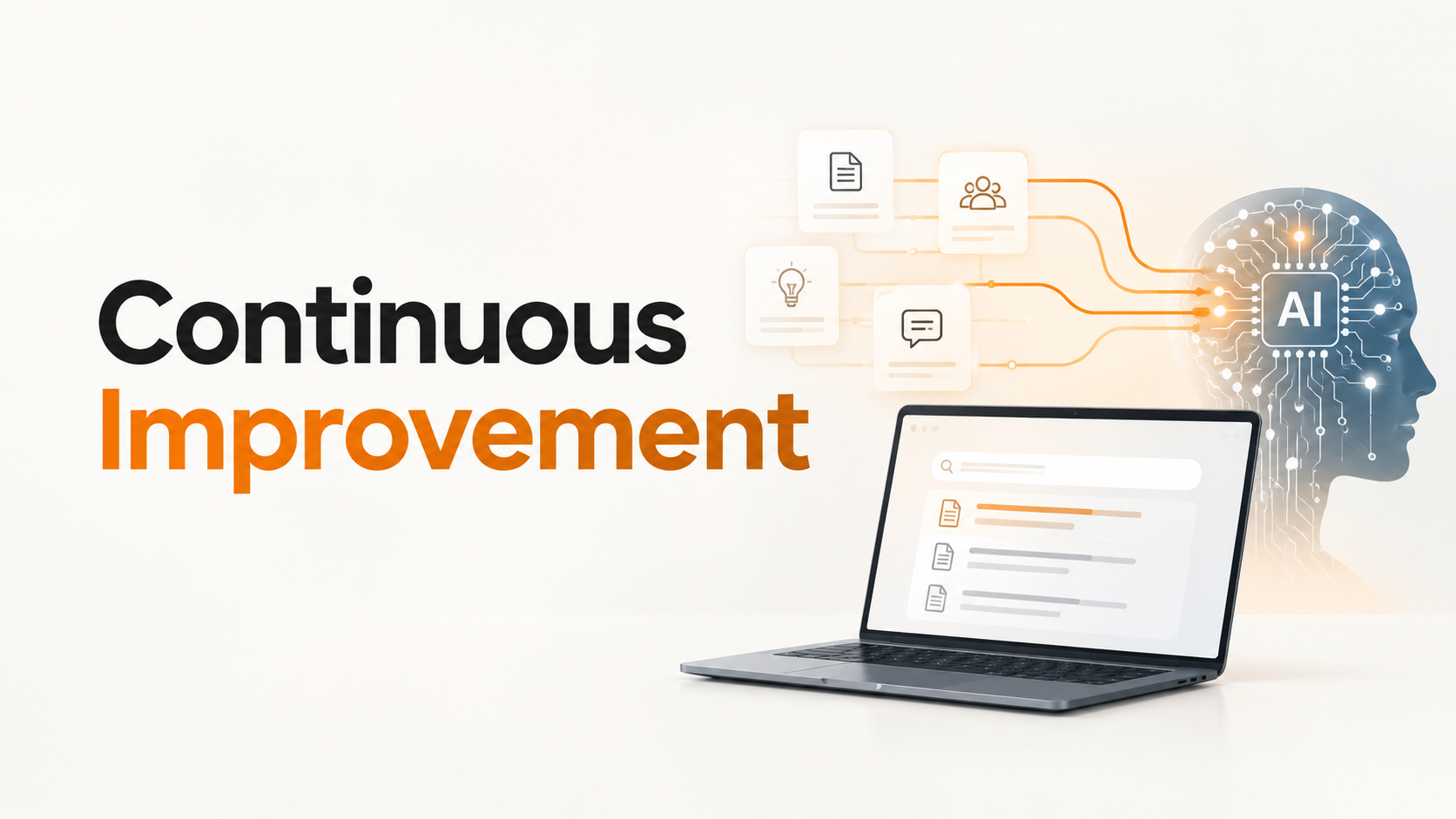
AI is changing continuous improvement by turning it from a paper-based, site-specific ritual into searchable organisational intelligence. Instead of depending on a handful of veteran engineers to remember which fix worked at which plant, symptom-based search and a centralised, multilingual improvement library let any team — in any country, in any language — find a solution that already exists inside the company. The payoff shows up directly on the balance sheet: problems that used to get re-solved three or four times across different sites get solved once, and reused everywhere.
The Same Problem, Solved Three Times
Picture a supervisor in a regional distribution hub troubleshooting a recurring dock scheduling issue. She spends two days working through it with her team, eventually landing on a fix. What she doesn’t know is that a sister facility on another continent solved the exact same problem two years earlier — the write-up is sitting in a spreadsheet on someone’s laptop, in a language she doesn’t read, filed under a project code that means nothing to her.
This isn’t a hypothetical. It’s the default state of continuous improvement in most large, multi-site operations. Lean methodologies remain one of the most reliable levers operations leaders have — organisations that run disciplined continuous improvement programs consistently report productivity gains in the 15–35% range. But that number only holds when the knowledge behind each improvement gets captured, shared, and reused. The moment it stays trapped in one person’s head or one region’s shared drive, the gain caps out at a single site, and the rest of the network keeps paying to relearn what was already known.
This is the tribal knowledge problem, and it’s become one of the more urgent conversations among Heads of Operational Excellence and COOs — not because continuous improvement stopped working, but because the way most companies store its output hasn’t kept pace with how global their operations have become.
What “Tribal Knowledge” Actually Costs an Operations Leader
Tribal knowledge is the unwritten expertise that lives in experienced people rather than in systems — the sound a bearing makes right before it fails, the workaround for a legacy process quirk, or the reason a setpoint gets nudged a certain way on the night shift. It’s real, valuable, and completely invisible to anyone who wasn’t in the room when it was learned. AI-powered data and intelligence solutions can help organizations capture, organize, and connect this valuable knowledge, making it easier to find and use when employees need it.
The costs compound in three specific ways:
- Departure risk. When a long-tenured specialist retires or moves on, the knowledge doesn’t get handed off — it walks out the door. Replacing that expertise isn’t just a hiring cost; it’s a capability gap that shows up in slower troubleshooting and inconsistent output for months afterward.
- Onboarding drag. New engineers and supervisors spend a large share of their ramp-up time reconstructing context that already exists somewhere in the organisation — it just was never systematically captured or made findable.
- Duplicated effort at scale. In a single-site operation, tribal knowledge is inconvenient. Across a global network with dozens of facilities and a dozen-plus languages, it’s a structural drag on every efficiency program running.
None of this is a documentation problem in the narrow sense. Most organisations do generate documentation — an improvement form, a root-cause report, a lessons-learned deck. The failure is retrieval, not creation. A PDF buried in a regional SharePoint folder, written in German, filed under last year’s project name, is functionally identical to knowledge that was never written down at all if nobody on another continent can find it.
Why a Wiki or Shared Drive Doesn’t Solve This
A common instinct is to centralise everything in one wiki or knowledge base and call it done. It helps — but only marginally, because the underlying problem isn’t storage, it’s discovery. A folder structure still assumes the person searching already knows the right keyword, the right project code, or the right regional naming convention. It also assumes they read the language it was written in.
This is the specific gap AI closes. Rather than requiring an exact keyword match, a symptom-based or semantic search layer lets a team describe the problem they’re actually experiencing — in their own words, in their own language — and surfaces the closest matching solutions from across the entire organisation, regardless of where or when they were originally logged. This approach also depends on grounding AI in enterprise data, so the results are based on the organisation’s own documented knowledge and experience rather than generic information. That’s the difference between a repository and searchable intelligence: one requires you to already know the answer exists; the other finds it for you.
What a Modern Improvement Knowledge Platform Actually Looks Like
An AI-enabled continuous improvement platform generally combines a small number of capabilities that, together, close the loop between “we solved this once” and “everyone can use it”:
- A centralised, searchable improvement library where every record — not just the polished ones — gets registered and made retrievable, instead of living in a regional silo.
- Symptom-based, natural-language search so frontline teams describe a problem in plain terms and get matched to prior solutions, rather than needing to guess the exact filing taxonomy.
- Multilingual access, so a fix logged in Mandarin is just as reachable to a team working in French, Dutch, or Arabic — removing language as a barrier to reuse.
- Real-time KPI dashboards giving management visibility into submission rates, projected savings, and adoption — turning continuous improvement from a culture initiative that’s hard to measure into a tracked, reportable program.
- Role-based permissions and audit trails, so access stays governed even as the library scales across business units and geographies.
- Single sign-on across devices, so the barrier to checking “has this already been solved” is low enough that people actually do it before starting from scratch.
A Working Example
Shvintech built exactly this kind of platform for a global logistics client whose improvement program had years of genuinely good work locked away in scattered spreadsheets and regional silos. Frontline teams in one country had no way of knowing that a problem they were facing had already been solved elsewhere, sometimes years earlier.
The platform now supports 16 languages across multiple global business units, with a centralised library, symptom-based search, and live KPI dashboards tracking submissions and savings. The client’s Head of Operational Excellence put it plainly: what had been scattered tribal knowledge became an organisational asset, with teams building on each other’s work instead of starting over each time. See the full case study →
What About the People Who Feel Like Their Knowledge Is Their Job Security?
This is the part most articles on this topic skip, and it’s usually the first objection that surfaces in the room when an improvement knowledge platform gets proposed. Experienced staff sometimes hesitate to formalise what they know — not out of stubbornness, but because unwritten expertise has historically been their leverage. If everyone can look up the fix, what’s left that’s uniquely theirs?
The honest answer is that the role shifts rather than disappears. Subject matter experts move from being the single point of failure who gets pulled into every escalation to being the curator whose judgment validates and improves what the system surfaces. That’s a promotion in substance, even if it doesn’t always feel like one on day one — and operations leaders who get ahead of that conversation, rather than treating adoption as a pure technology rollout, see meaningfully smoother buy-in.
How Should You Think About ROI Here?
The business case for an improvement knowledge platform rests on three measurable levers, and operations leaders evaluating this should ask vendors to quantify each one against their own numbers before committing:
- Reduced duplicate engineering effort — hours saved when a known fix is found instead of re-derived, multiplied across sites and problem frequency.
- Faster onboarding — the share of ramp-up time new hires currently spend reconstructing context that a searchable library would surface in minutes.
- Improvement velocity — whether the organisation is measurably solving more problems per quarter once submission friction and search friction both come down.
Most of the value is structural rather than one-time: the platform gets more valuable every month, because every new entry makes every future search better.
Frequently Asked Questions
Does this replace improvement events or the shop-floor culture behind them? No. The platform captures and surfaces the output of that activity — it doesn’t replace the gemba walks, the root-cause sessions, or the team discipline that produces improvements in the first place. It exists so that work doesn’t get lost after the event ends.
How is this different from storing improvement reports in SharePoint or a company wiki? A shared drive still requires the person searching to already know the right folder, keyword, or language. A symptom-based AI search layer lets someone describe the problem in plain language and get matched to the closest existing solution, regardless of where or in what language it was originally logged.
Will this threaten the standing of senior engineers who currently hold this knowledge informally? It shifts their role rather than eliminating it — from single point of contact for every recurring issue to curator and validator of what the system surfaces. Addressing this directly during rollout tends to matter more for adoption than any feature of the platform itself.
How long does it typically take to see results? Search and adoption metrics usually improve within the first few months, since they depend on making existing knowledge findable rather than generating new data. Measurable reductions in duplicated engineering effort typically show up over two to three quarters, as the library reaches critical mass.
Does a platform like this need to replace our existing QMS or LMS? No. It’s designed to sit alongside quality management and learning systems, feeding structured, searchable improvement data into a layer neither system is built to handle — natural-language, cross-language retrieval of informal problem-solving knowledge.
Where to Start
Most organisations already have years of genuinely good improvement work sitting in spreadsheets, regional folders, and people’s memory. The gap usually isn’t a shortage of improvement — it’s the absence of a system that makes existing improvement findable across sites, languages, and business units.
Shvintech works with global logistics, manufacturing, and operations teams on exactly this problem — building searchable, multilingual knowledge platforms that turn scattered continuous improvement work into a real, reusable organisational asset. Talk to Shvintech about a continuous improvement knowledge assessment to see where your own tribal knowledge is costing you the most.
Frequently Asked Questions FAQs
1. What is tribal knowledge, and how does it affect continuous improvement?
Tribal knowledge is the practical experience and expertise employees develop through their work but that may not be formally documented or easily accessible to others. In multi-site organizations, this knowledge often remains in employees’ memories, spreadsheets, or regional folders. As a result, different teams may repeatedly solve the same problems instead of reusing proven solutions. Capturing and sharing tribal knowledge helps businesses reduce duplicated effort, preserve expertise, accelerate problem-solving, and make continuous improvement more consistent across locations.
2. How can AI help companies capture and share tribal knowledge across multiple locations?
AI can help organizations organize existing improvement records, retrieve relevant solutions using natural-language queries, and translate or summarize information across languages. A centralized knowledge platform allows employees to describe a problem in their own words and discover solutions documented by teams at other locations. AI can also help structure information from shift notes and existing documents. For reliable results, organizations need accurate records, appropriate access controls, and human validation to ensure that suggested solutions are relevant to the local operating environment.
3. How is AI-powered knowledge management different from a shared drive or company wiki?
A shared drive or company wiki stores information, but employees often need to know the correct keyword, folder, project name, or language to find it. AI-powered knowledge management can use semantic search to identify relevant information based on the meaning of a query rather than exact keyword matches alone. For example, a supervisor searching for damaged cartons may find an improvement record about load stability, even when the original document uses different terminology. This makes existing operational knowledge easier to discover and reuse across teams.
4. What is symptom-based search, and why is it useful for operational teams?
Symptom-based search allows employees to search for solutions by describing what they observe rather than identifying the root cause first. For example, a warehouse employee experiencing recurring dock scheduling delays can describe the issue in everyday language and find related improvement records. This approach reduces the need to understand technical categories or internal filing conventions before searching. It is particularly useful in manufacturing, logistics, and other operational environments where frontline teams need quick access to practical solutions while working.
5. What is the ROI of an AI-powered continuous improvement knowledge platform?
The return on investment can be measured through reduced duplicated engineering effort, faster employee onboarding, and increased improvement activity. When teams reuse existing solutions instead of investigating the same problem repeatedly, they can save time and focus on new challenges. A searchable knowledge platform can also help new employees access documented expertise more quickly. Organizations should track metrics such as search success rates, time spent resolving recurring problems, improvement submissions, adoption, and verified savings. The actual ROI depends on existing inefficiencies, employee adoption, and the quality of the knowledge library.
6. Will an AI knowledge management platform replace experienced engineers or existing systems such as QMS and LMS?
An AI knowledge management platform is intended to support experienced employees rather than replace their judgment. Subject matter experts can shift from answering every recurring question to validating solutions, improving documentation, and handling complex problems. Similarly, a knowledge platform does not necessarily need to replace quality management systems (QMS) or learning management systems (LMS). It can complement these systems by making informal problem-solving knowledge searchable across departments, locations, and languages. Successful adoption depends on involving employees early and clearly explaining how the platform supports their work.
7. How long does it take to see results from an AI-powered knowledge management system?
Early improvements in search activity and adoption may become visible within the first few months when organizations make existing knowledge easier to find. Measurable reductions in duplicated engineering effort may take two to three quarters as the knowledge library grows and more employees begin reusing documented solutions. Results depend on the quality of existing records, the frequency of recurring problems, employee participation, and the effectiveness of the search experience. Starting with one recurring problem across one or two locations can help organizations validate the approach before expanding it.