
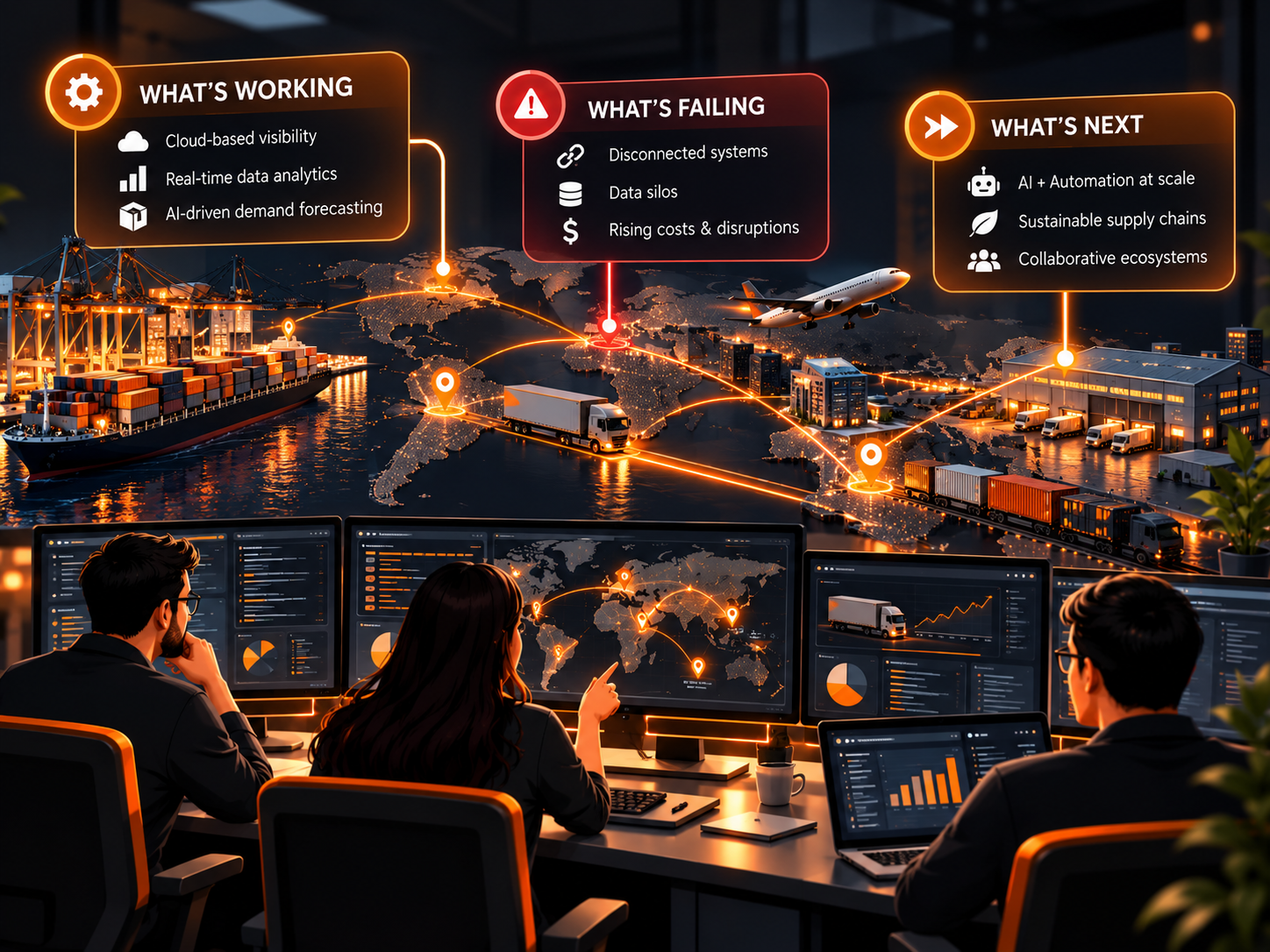
The boardroom narrative around supply chain technology has shifted completely in the last 18 months.
It used to be about resilience — building buffers against the next disruption. Now it’s about intelligence. The question executives are asking isn’t “are we protected?” It’s “are we fast enough?”
That shift matters, because the technology decisions following from each question are completely different. esilience buys you redundancy. Intelligence demands real-time data, connected systems and enterprise integration, and platforms that can act — not just report.
Here’s the reality check: According to Gartner Supply Chain Technology Trends data, 55% of supply chain leaders are actively increasing their technology spend in 2026. But spending more doesn’t automatically mean getting more. The gap between organizations that are genuinely gaining competitive advantage from their tech stack and those that are running expensive pilots with nothing to show is widening fast.
This post breaks down what’s actually working on the ground, what keeps failing despite the investment, and where the smart money is moving next.
What’s Actually Working in 2026
AI-Embedded TMS: From Add-On to Architecture
The transport management system was already the operational backbone of most logistics businesses. In 2026, the ones pulling ahead aren’t just using TMS — they’ve embedded AI directly into it.
The difference is significant. A traditional TMS records what happened. An AI-embedded TMS anticipates what’s about to happen.
That means:
- Dynamic carrier selection that adjusts in real time based on live capacity, historical performance, and cost
- Predictive ETA models that factor in weather, traffic, driver hours, and route history — not just scheduled departure times
- Automated rate confirmation that removes broker bottlenecks from the booking flow
- Exception management that surfaces the 3% of shipments that need human attention rather than making teams sift through everything
The operational shift is visible immediately. Brokers stop chasing confirmations. Customers get proactive updates. And operations managers start working from exceptions rather than reports.
What makes the difference between a TMS that delivers this and one that doesn’t? The quality of the underlying API design, the performance of the data layer, and the robustness of the cloud-native infrastructure and DevOps beneath it.
We learned this firsthand with a 3PL client whose three interconnected portals — broker, customer, and carrier — were running sluggishly because of poor API architecture and unoptimised SQL queries. The application was capable. The infrastructure underneath it was the problem. After a surgical refactor — rebuilding the APIs to RESTful standards, eliminating N+1 query patterns, and modernising the front-end component structure — response times improved by 80%.
No new AI features. No platform switch. The same system, with a proper foundation underneath it, became a competitive differentiator overnight.
Real-Time Track-and-Trace: Table Stakes, Executed Badly
Real-time visibility is no longer a feature. It’s expected. Every shipper, every customer, every broker assumes they can see where a shipment is at any moment.
The problem isn’t that companies don’t have track-and-trace. It’s that most implementations are broken in ways that don’t show up until something goes wrong.
Common failure patterns:
- Stale data masquerading as live data — a feed that updates every 15 minutes called “real-time”
- Carrier integration gaps — excellent visibility for major carriers, zero visibility for regional or last-mile partners
- Customer portal disconnected from ops portal — the customer sees one thing, the operations team sees another
- No escalation logic — the system tracks the shipment but doesn’t alert anyone when it goes off-plan
The organisations getting this right have built track-and-trace as an integrated workflow, not a display layer. Visibility triggers action. When a shipment falls behind its SLA window, the system doesn’t just update a dot on a map — it generates a task, notifies the relevant team, and logs the exception.
That’s the version that actually reduces costs and improves customer satisfaction. The display-only version just moves the anxiety from phone calls to dashboards.
Digital Twins: Moving from Demo to Deployment
A year ago, digital twins were the most overhyped concept in supply chain technology. Every vendor had one in a demo. Almost no one had one in production.
That’s starting to change — but slowly, and only in organisations that approached digital twins the right way.
The right way isn’t to model your entire supply chain at once. That’s where most initiatives stall. The right way is to start with a defined operational boundary — a single factory, a specific distribution corridor, a particular product family — and build a high-fidelity model of that slice.
What digital twins are genuinely delivering in 2026:
- Factory floor logistics simulation — running “what if” scenarios on layout changes, staffing, and route adjustments before committing to them
- Capacity planning — modelling demand shifts and their knock-on effects on warehouse throughput, carrier capacity, and labour
- Disruption response — simulating the impact of a port closure or carrier failure and identifying the fastest recovery path before one actually occurs
The in-factory logistics environment is particularly well-suited to digital twin technology because the operational variables are bounded and measurable. Production schedules, material movements, equipment utilisation, and delivery windows can all be modelled with high accuracy when the underlying data is clean.
We built a platform that proved this out—IFL (In-Factory Logistics)—deployed across manufacturing environments. The architecture includes real-time track-and-trace for parts and pallets, Kanban replenishment triggers, Milkrun scheduling, and an efficiency module that measures performance against standardized KPIs. The platform continues to evolve, with Airbus onboarding currently in progress.
The reason it worked is that it was purpose-built for the operational reality of a factory floor, not adapted from a generic supply chain platform. Domain specificity matters more than feature count.
What Keeps Failing (And Why)
The Pilot-to-Production Gap
This is the single most consistent failure pattern in enterprise supply chain technology right now.
A VP of Operations sponsors a technology pilot. The pilot runs for 90 days in a controlled environment with good data, engaged users, and dedicated support. Results look promising. The board approves a full rollout.
And then nothing scales.
The reasons are almost always the same:
Data quality falls off a cliff outside the pilot environment. The pilot used clean, curated data. Production has legacy records, duplicate entries, and systems that haven’t been updated since 2019. The AI models that worked beautifully in the pilot produce noise in production.
Integration complexity explodes. The pilot connected to two systems. Full deployment requires connecting to twelve, three of which have no modern API, and one of which sits on infrastructure that requires a vendor support ticket to touch.
Change management was treated as a rollout task, not a design constraint. The people who need to use the system daily weren’t involved in designing it, and the workflow changes required are more significant than anyone communicated.
The organisations that are successfully moving from pilot to production share one characteristic: they treat integration infrastructure as a prerequisite, not an afterthought. The platform gets built on top of a data layer that’s already clean, connected, and flowing in real time.
Disconnected Systems Undermining Connected Ambitions
You can have the best TMS on the market, a real-time visibility platform, a digital twin for your flagship distribution centre, and a warehouse management system that your team loves — and still be operating blind.
Because if those systems don’t talk to each other, the intelligence you’re buying stays trapped inside each platform.
The executive sees four dashboards. None of them share context. The TMS doesn’t know what the warehouse management system just flagged. The visibility platform can’t read the carrier data from the TMS. The digital twin is modelling a reality that’s already 24 hours old.
This isn’t a technology problem. It’s an integration architecture problem. And it’s more common than most technology leaders publicly admit, because admitting it means admitting that the last several years of platform investment was built on a foundation that couldn’t support it.
What’s Coming Next: Q3 2026 and Beyond
Agentic AI in Supply Chain Operations
As highlighted in McKinsey – The State of AI, the shift from AI as an analytics layer to AI as an operational agent is already happening in logistics. The early adopters aren’t in the press releases yet — they’re quietly gaining 15 to 20% efficiency advantages while the rest of the industry is still debating whether to pilot.
What agentic AI looks like in practice:
- An agent that monitors inbound carrier feeds, detects an at-risk shipment, checks SLA thresholds against the CRM, and sends a proactive customer notification — without a human in the loop
- An agent that manages Kanban replenishment triggers, adjusts order quantities based on real-time consumption data, and escalates exceptions when supplier lead times shift
- An agent that reviews freight invoices against contracted rates, flags discrepancies, and initiates dispute workflows automatically
None of this requires a breakthrough in AI capability. It requires clean data, connected systems, and clear process logic. The technology is ready. The question is whether the infrastructure underneath it is.
Supply Chain Intelligence Platforms
The next generation of supply chain technology won’t be point solutions for specific functions. It will be platforms that unify operational intelligence across the entire logistics value chain — from supplier to customer, from factory floor to final mile.
The competitive advantage goes to the organisations that have already built the integration layer to support this. They can plug in new capabilities as they emerge without rebuilding foundations every time.
The ones that haven’t will face the same choice they’ve been deferring for years: invest in the foundation now, or keep paying the compounding cost of fragmentation.
The Common Thread
Every technology that’s working in supply chain right now — AI-embedded TMS, real-time track-and-trace, digital twins, agentic workflows — shares one dependency on robust Data & AI Solutions.
Clean, connected, real-time data.
And every technology that’s failing shares one root cause.
The data infrastructure underneath it wasn’t built to support it.
The organisations that are winning in 2026 didn’t just buy better software. They built a better foundation first. They invested in integration architecture, data quality, and operational platforms that were designed around how their business actually works — not how a vendor demo suggests it should.
That’s a harder sell internally than a new TMS or a flashy pilot. But it’s the decision that separates the companies sharing impressive case studies from the ones quietly wondering why their tech spend isn’t moving the needle.
See This in Practice
If you want to see what purpose-built, production-ready supply chain technology actually looks like in operation — not in a vendor demo, but deployed across real factory floors for clients — read the IFL case study.
It covers how the platform was built, why off-the-shelf solutions failed to meet the domain requirements, and what happened commercially when the right technology foundation was in place.
Or speak directly with our team about what this looks like for your operation: srini@shvintech.com | +1 (404) 441 3667
Shvintech is an enterprise IT partner specialising in Data & AI, Automation, Integration, Cloud, and Enterprise IT. Headquartered in Alpharetta, Georgia, with delivery centres in Hyderabad, Visakhapatnam, and Sydney. Over 20 years of excellence. 95% client retention. We make IT happen.
Frequently Asked Questions FAQs
1. What are the most important supply chain technology trends in 2026?
The major supply chain technology trends in 2026 include AI-embedded transportation management systems (TMS), real-time shipment visibility, digital twins, agentic AI, and integrated supply chain intelligence platforms. These technologies help organizations anticipate disruptions, automate routine decisions, improve operational visibility, and respond faster to changing conditions. Their success depends on clean, connected, real-time data and an integration architecture that allows different systems to work together.
2. How is AI transforming transportation management systems (TMS)?
AI is transforming transportation management systems by helping logistics teams move from recording shipment activity to anticipating and responding to operational changes. AI-enabled TMS capabilities can support dynamic carrier selection, predictive estimated times of arrival (ETAs), automated rate confirmation, and exception management. These features help teams prioritize shipments that need attention, improve customer communication, and make transportation decisions using current operational data. Effective implementation also requires reliable APIs, well-performing databases, and robust cloud infrastructure.
3. Why do real-time supply chain visibility systems fail?
Real-time supply chain visibility systems often fail because their data is stale, carrier integrations are incomplete, operational and customer portals show inconsistent information, or exception alerts are missing. A tracking dashboard alone does not solve these problems. Effective visibility connects shipment data with operational workflows so that delays can trigger tasks, notify the appropriate teams, and record exceptions. This allows organizations to respond to disruptions instead of simply observing them.
4. What is a digital twin in supply chain management, and how is it used?
A digital twin in supply chain management is a digital representation of a physical operation or process that can be used to analyze performance and evaluate potential changes. Supply chain teams can use digital twins to simulate factory-floor logistics, warehouse capacity, staffing changes, material movements, and disruption scenarios. Starting with a clearly defined operational area, such as a factory or distribution corridor, helps organizations build a useful model before expanding it across a larger supply chain.
5. Why do supply chain technology pilots fail when moving to production?
Supply chain technology pilots often fail to scale because production environments are more complex than controlled test environments. Data quality may deteriorate, integrations may expand from a few systems to many, and existing applications may lack modern APIs. User adoption can also suffer when employees are not involved in designing the new workflows. Successful scaling requires production-ready data pipelines, reliable integration infrastructure, realistic testing, and change management that accounts for how teams actually work.
6. How does enterprise integration improve supply chain performance?
Enterprise integration connects systems such as transportation management, warehouse management, shipment visibility, and digital twin platforms so they can exchange data and coordinate actions. Without integration, each application may provide only a partial view of operations, leaving teams to reconcile information manually. A well-designed integration architecture improves data consistency, enables faster exception handling, and allows new capabilities to be introduced without repeatedly rebuilding connections between existing systems.
7. How can agentic AI automate supply chain operations?
Agentic AI can automate multi-step supply chain workflows by monitoring operational data, identifying conditions that require action, and initiating predefined tasks. For example, an AI agent could detect an at-risk shipment, check its service-level agreement (SLA), and trigger a customer notification. Other use cases include managing Kanban replenishment, flagging freight invoice discrepancies, and initiating dispute workflows. Reliable deployment requires clean data, connected systems, clear business rules, appropriate permissions, and escalation mechanisms for exceptions that need human judgment.